
The gross NPAs of some public sector banks, including State Bank of India and Punjab National Bank have crossed 4 per cent of the total assets at the end of March, 2013.
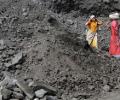
The economy can't grow without increasing electrification, which requires more power plants, and given coal is the cheapest form of fuel and is abundant, it makes sense that India is looking to boost the use of the fuel.

Tata Motors on Monday launched the country's first CNG truck in the medium and heavy commercial (M&HCV) vehicle segment in the 28- and 19-tonne nodes. Most truck makers, including Tata Motors, currently offer CNG only in the small and light commercial vehicle segments. The company also launched a fleet of seven trucks in the intermediary and light commercial vehicle (I&LCV) segment, meant for varied applications.

Sectors which attract maximum foreign inflows include services, computer software and hardware, telecommunications, automobile and trading.

Fuelled by the $57.8-billion merger of HDFC twins (HDFC Ltd and HDFC Bank), M&A (merger and acquisition) transactions in India touched a record high of $124.2 billion in the first half of 2022-23. Bankers said with several transactions, including the government's stake sale in IDBI Bank and Hindustan Zinc in the pipeline, the ongoing financial year will end up as the best year for M&A activity in the country. Apart from the HDFC transaction, the $6.5-billion acquisition of Holcim stake by the Adani family and L&T's $3.2-billion acquisition of Mindtree added to the record transactions in the first half of FY23.

A series of steps taken by the government to promote ease of doing business and liberalisation of foreign direct investment norms have helped India receive record FDI inflows so far this year, and implementation of measures like PM Gati Shakti, single window clearance and GIS-mapped land bank are expected to further push investments in 2022. Notwithstanding the global slowdown and the COVID-19 pandemic, total foreign direct investments into India rose to a record $81.72 billion in 2020-21. During April-July this fiscal, FDI (foreign direct investment) into the country increased by 62 per cent to $27.37 billion.

Recalibrating data of past years using 2011-12 as the base year instead of 2004-05, the Central Statistics Office estimated that India's GDP grew by 8.5% in the financial year 2010-11 and not at 10.3% as previously estimated.

The U.S. economy grew faster than initially thought in the second quarter.

As the world celebrated International Day of Persons with Disabilities (PwD) on December 3, corporate India has kept up with efforts to make workplaces more inclusive and accessible. Organisations across sectors are taking initiatives such as equipping offices with practical work tools like Braille-friendly and voice-enabled lifts and screen readers. While inclusion has gained pace, only 11.3 per cent (or 3.4 million out of 30 million) Indians with disabilities have jobs.
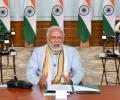
Whether it took the corona crisis to bring about the transformation, or otherwise, the change ought to be welcome, notes Virendra Kapoor.

India Ratings expects long products demand growth to be sharp, supported by a demand push from the government-led infrastructure investments in affordable housing, railways, rural electrification and road networks.

Gautam Adani's alleged proximity to Narendra Modi may dent the latter's self-styled image of incorruptibility, points out Kanika Datta.
Sectors which attracted maximum foreign inflows during April-June 2019-20 include services (USD 2.8 billion), computer software and hardware (USD 2.24 billion), telecommunications (USD 4.22 billion), and trading (USD 1.13 billion), the commerce and industry ministry data showed.

The dollar moved higher, while prices for US government debt fell, as traders ramped up bets the Federal Reserve would raise interest rates in March

10 stocks which are most popular with brokerages right now and are expected to deliver maximum upside over the next 12 months.

'If you weed out corruption, you will bring glory to Goa.'

Niti Aayog CEO Amitabh Kant on Tuesday said it is difficult to carry out tough reforms in India and emphasised that more reforms are needed to make the country competitive in the global environment. Addressing a virtual event organised by Swarajya magazine, Kant said for the first time, the Centre has carried out hard reforms across sectors, including mining, coal, labour, agriculture, and the next wave of reforms must be pushed by the states.

Billionaire Mukesh Ambani's Reliance Industries Ltd climbed two spots to No. 53 on Forbes' latest Global 2000 list of public companies worldwide. Forbes Global 2000 ranks the largest companies in the world using four metrics: sales, profits, assets and market value, Forbes said releasing the 2022 ranking of the world's top 2,000 companies. Reliance is the top-ranked Indian firm on the list, followed by State Bank of India at No. 105, HDFC Bank at No. 153 and ICICI Bank at No. 204.

The economy has shown sharp resilience in the past and has also bounced back in good time. We could hence expect a similar trajectory next year, observes Madan Sabnavis, chief economist, CARE Ratings.

Manufacturing sector, which constitutes over 75 per cent of the index, grew at 5.5 per cent in November compared to a decline in output by 4.6 per cent earlier

If I focus on today, I will have to give up the future, says T K Kurien.
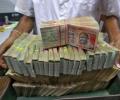
Brokerage house Nomura today said the downward revision of FY'13 growth figure by the Central Statistics Office will have a positive base effect for GDP expansion in the current fiscal.
Richest Indian Gautam Adani's ports-to-power-to-cement conglomerate is "deeply overleveraged" with the group predominantly using debt to invest aggressively across existing as well as new businesses, CreditSights, a Fitch Group unit, said on Tuesday. In a report titled 'Adani Group: Deeply Overleveraged', CreditSights said, "In the worst-case scenario, overly ambitious debt-funded growth plans could eventually spiral into a massive debt trap, and possibly culminate into a distressed situation or default of one or more group companies." Starting out as a commodities trader in the late 1980s, the Adani group has diversified from mines, ports and power plants into airports, data centers and defence.
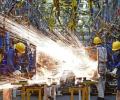
Capital goods output rose by a robust 20 per cent in the month under review as against a contraction of 2.4 per cent earlier.
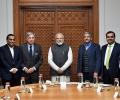
Further stimulus measures are expected in the upcoming Budget where the focus is likely to be on reforms, including some structural measures such as reducing red tape and boosting foreign direct investment. The meeting with industrialists is in the series of discussions that Modi has had during the last couple of weeks to seek suggestions to revive growth.

India's GDP is estimated to contract by a record 7.7 per cent during 2020-21 as the COVID-19 pandemic severely hit the key manufacturing and services segments, as per government projections released on Thursday. Amid overall decline in economic activities, some respite was provided by the agriculture sector and utility services like power and gas supply, which have been projected to post positive growth during the current fiscal ending March 2021.

Sales expansion also down 4.4%
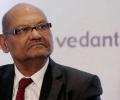
With a robust outlook for mineral-led growth in India, Anil Agarwal-led Vedanta Limited is looking to invest up to $20 billion across its businesses, which includes doubling of silver production and steel capacities. In a virtual press conference had last month, Agarwal said the company planned a capex of $5 billion over a period of three years. The company has not given a timeline for $20-billion investment.

E-commerce players also realise the value proposition women employees bring to the table.
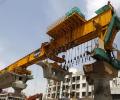
The combined net sales of 42 listed construction and capital goods companies that have declared their third-quarter results so far were down 2.3 per cent year-on-year in Q3FY21 while core operating profit was up just 4.9 per cent YoY during the quarter.

'Increased allocations for MNREGA could have provided the much needed push to rural demand and consumption at a time when recovery continues to remain uneven.'

Department of Economic Affairs secretary Atanu Chakraborty said that equity capital flows have been positive this year.

During April-February, industrial output grew at 2.6 per cent compared with a growth of 2.8 per cent in the year-ago period.

It is imperative to check the basics of a company before investing in it

March and April payrolls were revised to show 32,000 more jobs.

One hundred and forty nine new individuals joined the rich list club of 1,103 Indians across 122 cities who cumulatively accumulated a wealth of Rs 100 trillion. Bengaluru -based Kaivalya Vohra, 19, of grocery delivery application Zepto is the youngest self-made and the youngest rich individual, according to IIFL Wealth Hurun India Rich List 2022. The report found 1,103 Indians with a networth of Rs 1,000 crore each - an increase of 62 per cent over five years. There are 221 billionaires (Rs 100 crore networth) in India on the 2022 list - down 16 compared with last year, while 13 people born in the 1990s made it to the list, all self-made.

The government has held back the release of complete data of the Index of Industrial Production (IIP) for April, as was done for the same month last year due to the COVID-19 lockdown. Last year in June, the National Statistical Office (NSO) had held back the release of complete IIP data due to the effect of the nationwide lockdown on factory output. This year too industrial production was hit due to lockdown restrictions imposed by states to curb the second wave of the pandemic.

Omkeshwar Singh, head, Rank MF, a mutual fund investment platform, answers your queries.

Singapore continued to be the largest source of FDI in India followed by Mauritius, the US, the Netherlands and Japan.

India's economy could prove to be the "most resilient" in the subregion of South and South-West Asia over the long term, according to a report by the UN, which says a positive but lower economic growth post COVID-19 pandemic and the country's large market will continue to attract investments. The report titled 'Foreign Direct Investment Trends And Outlook In Asia And The Pacific 2020/2021', and compiled by United Nations Economic and Social Commission for Asia and the Pacific (UNESCAP), stated that inward FDI flows to South and South-West Asia slightly decreased by 2 per cent in 2019, from $67 billion in 2018 to $66 billion in 2019. The growth, however, was mainly driven by India, which accounted for 77 per cent of the total inflows to the subregion and received $51 billion in 2019, up 20 per cent from the previous year.
